
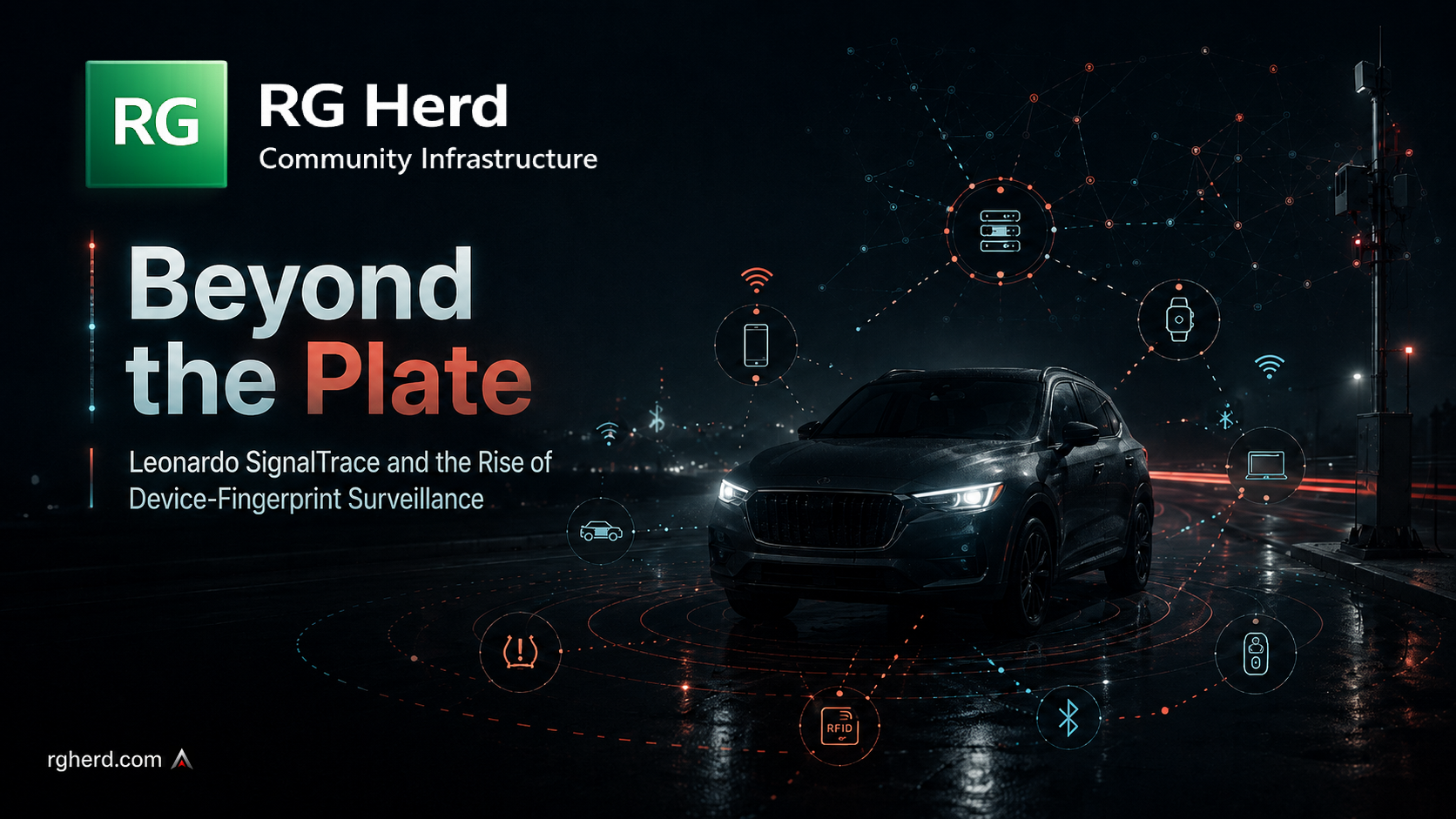
⚠️ The warning: the plate is no longer the only identifier.
A license plate reader identifies a vehicle by something mounted to the outside of it. Leonardo’s ELSAG SignalTrace is designed to identify something less visible: the cluster of electronic devices moving with that vehicle.
Leonardo markets SignalTrace as a law-enforcement signal-intelligence layer that collects and correlates radio-emitting device information with time, location, and license-plate records. The company describes the resulting combination as an electronic fingerprint that can help identify recurring vehicles, devices, and travel patterns even when a readable plate is not available.
The system matters because it changes the surveillance target. Instead of relying only on a plate, investigators can look for a recurring combination of nearby signals: a phone, smartwatch, headphones, vehicle infotainment system, tire-pressure sensor, RFID tag, or other detectable radio source.
The plate reader identifies the car. SignalTrace is designed to identify the radio entourage moving with it.
SignalTrace does not need to decrypt messages or read their content to create surveillance value. The useful information is the pattern: which devices were together, where they appeared, when they appeared, and how often the same combination returned.
What SignalTrace actually does
Leonardo describes strategically placed SignalTrace sensors that detect electronic communication patterns and device identities in their vicinity. Those observations can be paired with ELSAG license-plate-reader records and stored for later analysis.
The system is designed to look for combinations that repeatedly appear together. A single device may be common or transient. A recurring group of devices moving together can become more distinctive.
The plate can become optional
Leonardo explicitly markets SignalTrace as useful at locations where an ALPR camera is not installed. A camera-equipped collection point can associate a plate with an electronic fingerprint, while later collection points can look for that electronic pattern without capturing another readable plate.
That is the architectural shift. The plate begins as an anchor, but the recurring device cluster can become another tracking token.
A standalone detector answers: “What signals are nearby?” SignalTrace is marketed to answer a different question: “Have we seen this combination before, what was it associated with, and where else has it appeared?”
What kinds of devices can become part of the fingerprint?
Leonardo’s patent materials describe a broad collection environment rather than one specific radio protocol. The examples include phones, tablets, laptops, smartwatches, fitness trackers, headphones, portable hotspots, vehicle entertainment and navigation systems, Bluetooth interfaces, tire-pressure sensors, RFID credentials and asset tags, Bluetooth key finders, and other detectable electronic devices.
Those devices do not all behave the same way. Some transmit frequently. Some respond only under particular conditions. Some identifiers can change. Some technologies operate at very short range. SignalTrace should therefore not be described as a universal scanner that extracts a permanent serial number from everything nearby.
Detectable does not mean permanently identifiable. Modern wireless systems include privacy protections, changing identifiers, different transmission intervals, and radically different radio ranges. The surveillance model becomes more powerful through repeated correlation rather than through any guarantee that every individual device exposes one permanent identifier.
Phones and Wi-Fi identifiers
Modern Apple and Android devices use MAC-address randomization specifically to make passive Wi-Fi tracking more difficult. Depending on operating system, configuration, network state, and protocol behavior, the address visible to a nearby observer may not remain constant indefinitely.
That limitation matters. It means a simplistic claim such as “SignalTrace permanently identifies every phone by its MAC address” would be unsupported.
But identifier rotation does not eliminate the broader correlation problem. SignalTrace is marketed around recurring combinations. If several observable characteristics or devices repeatedly appear at the same times and places, the system can attempt to associate the cluster even when one element changes.
A privacy feature that weakens one identifier does not necessarily defeat a system designed to correlate many identifiers together.
Vehicle electronics may be particularly persistent
Vehicles contain radios that may remain associated with the same car for years. Infotainment systems, Bluetooth interfaces, aftermarket electronics, telematics equipment, and tire-pressure monitoring sensors can all contribute signals or identifiers under the right collection conditions.
Tire-pressure monitoring systems are especially notable because individual TPMS sensors can transmit identification codes as part of their radio messages. A vehicle commonly carries several sensors at once. If those identifiers can be collected reliably at useful distances, the combination could contribute a relatively persistent vehicle signature.
The existence of unique TPMS identifiers is established. Leonardo’s patents specifically contemplate tire-pressure sensors as electronic-signature inputs. What public documentation does not establish is SignalTrace’s real-world roadside accuracy, effective collection distance, or false-match rate for TPMS-based association.
RFID requires more careful language
RFID is a family of technologies, not one uniform beacon. Active tags can contain their own power source and transmit over useful distances. Passive tags depend on energy supplied by a nearby reader and generally operate over much shorter ranges.
Leonardo’s patent materials contemplate RFID access cards, asset tags, luggage or pallet tags, and RFID-enabled pet collars among possible electronic-signature sources. That does not establish that every passive RFID object can be silently detected from a roadside sensor.
No, this does not establish roadside scanning of implanted pet microchips
Claims about SignalTrace detecting “pet microchips” need a major qualification. Veterinary microchips implanted under an animal’s skin are passive RFID transponders. They contain no battery and normally respond only when energized by a compatible scanner held close to the animal.
Leonardo’s patent language describes an RFID pet collar. That is materially different from proving that SignalTrace can read an implanted veterinary microchip through an animal, vehicle body, and roadside distance.
There is public support for RFID tags and RFID-enabled pet collars appearing in Leonardo’s contemplated signal environment. We found no evidence establishing routine roadside collection of implanted pet microchips. ALERTS will not present that claim as fact.
The surveillance value is metadata, not message content
Leonardo emphasizes that SignalTrace does not decrypt communications or read message content. That distinction is technically real. It is not a complete privacy answer.
The investigative value comes from metadata and association:
- which signal or identifier was observed;
- where it was observed;
- when it was observed;
- which plate or vehicle was nearby;
- which other devices were present;
- how often the same combination appeared together;
- and where that combination appeared before or afterward.
No message needs to be opened to infer that two devices routinely travel together, that a recurring cluster visited the same location, or that a device previously associated with one vehicle later appeared with another.
Content surveillance asks what you said. Association surveillance asks where you were and who or what was repeatedly with you. SignalTrace is designed around the second category.
From vehicle tracking to association tracking
Leonardo explicitly markets SignalTrace for identifying devices or electronic signatures that repeatedly travel together. That moves the system beyond recognizing one vehicle at one location.
If two electronic fingerprints repeatedly appear on the same roads, at the same collection points, or in close temporal sequence, the system can surface a possible association. Leonardo describes this in terms that include movement analysis, convoy identification, and recurring travel relationships.
The important word is association. A surveillance system does not need to know everyone’s legal name before it can build a useful relationship graph. Persistent pseudonymous identifiers can still reveal patterns of co-travel and repeated proximity.
A radio identifier may begin as an unknown device. Repeated appearances at a home, workplace, traffic stop, access-controlled building, known vehicle, or other identifying event can gradually connect that pseudonymous signal to a person or group.
What happens when a device changes vehicles?
One of the most consequential possibilities follows directly from the correlation model. If a device that repeatedly appeared with Vehicle A later begins appearing with Vehicle B, investigators may infer that the device—and potentially the person carrying it—changed vehicles.
That does not prove who was driving or even who possessed the device at every moment. Phones are shared. Vehicles are borrowed. Headphones are left behind. Employees ride together. A device can be transported without its owner.
But as an investigative lead, the association can still be powerful. The surveillance target is no longer limited to the physical plate attached to one automobile. The recurring electronic signature can potentially bridge observations across different vehicles.
A plate belongs to a vehicle. A recurring device may follow a person.
Convoy and co-travel analysis
Leonardo advertises the ability to identify electronic signatures that travel together and to recognize convoy-like movement patterns. In practice, that means repeated observations can be compared across time and geography to find clusters moving in coordination.
There are legitimate investigative uses for that capability. It could help identify organized vehicle theft, coordinated trafficking, stolen-property movement, or vehicles repeatedly accompanying a known target.
The same capability can also map lawful association. A group traveling to a demonstration, religious gathering, union activity, political meeting, community event, clinic, mutual-aid operation, or private social gathering can generate exactly the kind of repeated co-location pattern the system is designed to detect.
Association data can reveal more than simple movement. Repeated location patterns can expose political, religious, medical, professional, familial, and social relationships without ever opening a message or recording a conversation.
The collection point does not need to be a roadside camera
SignalTrace is particularly important because Leonardo does not limit the concept to ordinary roadside ALPR installations. Its materials describe electronic-signal collection at locations where a plate reader may be impractical or unnecessary.
Examples described by Leonardo include transportation facilities, malls, shopping areas, event sites, and other locations where electronic signatures can be observed independently of a license-plate image.
That means the surveillance surface can extend beyond roads.
Roadside collection
- Plate read
- Vehicle description
- Timestamp and location
- Nearby electronic signals
- Initial fingerprint association
Camera-free collection
- Transit stations
- Parking structures
- Malls and shopping areas
- Event locations
- Other strategically placed RF sensors
Backend analysis
- Recurring fingerprints
- Historical searches
- Movement reconstruction
- Co-travel relationships
- Vehicle or device association
The invisible expansion of ALPR infrastructure
This is the infrastructure problem.
A traditional public debate might focus on the number of plate-reader cameras installed beside roads. SignalTrace demonstrates why that inventory can become incomplete. Once the analytical system can ingest radio observations from standalone collection points, the tracking network is no longer defined by where cameras exist.
A plate reader can establish an association. Another sensor can continue it.
The visible camera becomes one enrollment point into a larger identification system.
If historical fingerprints, device associations, standalone sensors, and backend search remain available, removing one branded ALPR unit does not necessarily dismantle the broader surveillance capability. The sensor can change while the correlation infrastructure survives.
404 Media’s description gets to the heart of it
404 Media reported on SignalTrace as technology that would expand license-plate-reader infrastructure toward tracking the phones, AirPods, smartwatches, and other devices associated with particular vehicles.
That is a useful shorthand, with one qualification: the public evidence does not establish that every consumer device can always be persistently tracked. Modern identifier randomization and radio behavior complicate that picture.
But the broader conclusion is accurate. SignalTrace is designed to take surveillance that begins with the vehicle and extend it toward the devices—and potentially the people—moving with that vehicle.
SignalTrace turns ALPR from a plate-centered observation system into a multi-signal correlation system. Its purpose is not merely to detect radios. It is to preserve and compare their relationships across time and place.
Association analysis can also create false associations
A sensor detecting a device near a vehicle does not automatically prove that the device was inside the vehicle, belonged to the driver, or belonged to anyone police suspect.
A detected signal could come from a passenger, pedestrian, nearby employee, adjacent vehicle, borrowed device, shared device, cargo tag, or equipment left behind. Dense streets, parking lots, transit areas, and event sites can contain large numbers of overlapping radio sources.
Repeated correlation may increase confidence, but it can also harden a mistaken assumption. Once an uncertain device-to-vehicle relationship becomes part of an investigative record, later observations may be interpreted through that original association.
A recurring signal near a vehicle is evidence of proximity. It is not, by itself, proof of ownership, occupancy, identity, criminal coordination, or intent. Any investigative system using these associations needs documented confidence thresholds, validation procedures, and mechanisms for correcting erroneous links.
The accuracy problem is largely invisible
Leonardo publicly describes SignalTrace’s capabilities, but we found no independent public benchmark establishing its false-positive rate, false-association rate, effective roadside collection distance, or accuracy at separating devices in adjacent vehicles.
Public materials also do not clearly disclose how long a combination must recur before becoming a fingerprint, how identifier rotation affects confidence, how noisy environments are filtered, or what level of human verification is required before an association is treated as an investigative lead.
Those omissions matter because correlation systems can appear precise after the fact. A map showing several matching detections may look authoritative even when the underlying association was probabilistic.
Leonardo’s public materials and patents establish the intended surveillance architecture. They do not provide enough public evidence to independently verify real-world accuracy, error rates, or the reliability of every advertised association.
What Leonardo’s patents prove—and what they do not
Leonardo’s electronic-signature patent family is unusually useful because it describes the architecture in detail. The patents contemplate collecting RF, Bluetooth, RFID, and other electronic signals, correlating those signals with visual identifiers such as license plates, building intelligence databases, and tracking common locations and movements of people, vehicles, and devices.
The patents also describe electronic-signal sensors operating as standalone collection systems or alongside ALPR infrastructure.
That is strong evidence of design intent and technical scope.
But a patent is not a deployment report. It does not prove that every contemplated feature exists in the current commercial product, that every radio technology listed is enabled in every installation, or that any particular police agency has activated the full patented capability set.
Patents establish what Leonardo designed and claimed. They do not establish where every capability is deployed.
SignalTrace is a real marketed product. Public deployment remains opaque.
SignalTrace is not merely a speculative patent. Leonardo publicly markets the product under its ELSAG law-enforcement portfolio and describes its electronic-fingerprint, movement, association, and camera-free collection capabilities.
What remains much harder to establish is where the system is operating.
During research for this article, ALERTS did not locate a sufficiently documented public record allowing us to confidently identify a specific U.S. law-enforcement agency as operating a production SignalTrace deployment.
That absence should not be exaggerated in either direction. It does not prove that SignalTrace has never been deployed. It also does not justify claiming that police departments across the country are already operating it.
SignalTrace is patented and actively marketed. Publicly confirmed operational deployments remain unclear. Procurement records, demonstrations, pilots, reseller agreements, and local policy documents will be important evidence as adoption develops.
The Fourth Amendment question just became more serious
SignalTrace itself has not produced a reported Supreme Court decision. But the constitutional environment surrounding digital location surveillance changed significantly in June 2026.
In Chatrie v. United States, the Supreme Court held that police conducted a Fourth Amendment search when they acquired a person’s Google Location History data. The Court concluded that individuals have a reasonable expectation of privacy in their cell-phone location information.
That decision matters because it rejects the idea that technologically generated location data becomes constitutionally insignificant merely because investigators are not physically following someone.
SignalTrace presents a different factual problem. Chatrie involved government acquisition of stored location information from Google. SignalTrace is designed around sensors collecting electronic signals directly from physical environments.
So Chatrie does not automatically establish that every SignalTrace detection requires a warrant.
But it strengthens the constitutional significance of what happens after collection: persistent location history, retrospective searches, association mapping, and the reconstruction of a person’s movements through electronic identifiers.
Chatrie answers an important question about digital location privacy; it does not yet answer SignalTrace. Courts would still need to determine how Fourth Amendment protections apply to direct RF collection, persistent electronic fingerprints, historical searches, and association analysis.
Why short location histories can still expose sensitive activity
The privacy issue is not limited to following someone continuously for weeks.
A relatively short sequence of observations can reveal attendance at a political demonstration, medical facility, religious service, union meeting, private residence, recovery program, legal office, or other sensitive destination.
When location is combined with co-travel information, the system can reveal not only where a device appeared but which other recurring devices appeared with it.
That combination—location plus association—is substantially more revealing than a single plate read.
One roadside detection may reveal little. A searchable archive of repeated detections can reveal movement. Repeated device clusters can reveal association. Connecting those observations to vehicles and known identities can transform ordinary radio metadata into a detailed investigative history.
SignalTrace is not Flock—but the architecture is the warning
SignalTrace is a Leonardo product. ALERTS found no evidence establishing that it is a Flock Safety product, a Flock subsystem, or currently integrated into Flock’s platform.
That distinction matters.
The larger surveillance lesson is not that every vendor already shares one backend. It is that modern law-enforcement systems are increasingly designed around sensor fusion: cameras, radio detectors, databases, location records, CAD events, access systems, video, and other inputs feeding analytical software that can search and correlate them together.
SignalTrace illustrates how quickly a system can move beyond the thing the public sees installed beside the road.
The camera may be the most visible sensor. The database and correlation engine can become the more consequential infrastructure.
Surveillance capability should be evaluated by the full data path: what sensors collect, what identifiers are retained, what systems receive the data, how long records survive, what searches are possible, and which outside agencies or vendors can access the results.
What local governments and agencies should be required to disclose
A public debate over SignalTrace should not be limited to whether a city council approved a box mounted on a pole. The important questions are architectural and operational.
- Which SignalTrace hardware and software modules have been purchased, leased, demonstrated, or piloted?
- Where are collection sensors installed?
- Which radio technologies or device classes are enabled?
- Are electronic signatures collected when no plate reader is present?
- What identifiers are retained from each detection?
- How long are raw observations, fingerprints, and association records stored?
- What confidence score is required before two observations are treated as the same device or fingerprint?
- Can investigators search historical electronic fingerprints without a warrant?
- Can the system identify devices that moved from one vehicle to another?
- Can it surface convoy, co-travel, or recurring-association patterns?
- Which agencies can query the data?
- Can Leonardo personnel, contractors, fusion centers, task forces, or neighboring jurisdictions access it?
- Are searches audited?
- Can erroneous device-to-person or device-to-vehicle associations be corrected?
- What policies restrict use involving protests, religious activity, medical facilities, immigration enforcement, journalists, or other sensitive activity?
What to request under public-records laws
For communities investigating possible adoption, the most useful records may not contain the word “surveillance.” Procurement and implementation records often reveal more than public-facing policy summaries.
Procurement
Contracts, quotes, invoices, sole-source justifications, purchase orders, grant applications, reseller documents, and equipment inventories mentioning Leonardo, ELSAG, SignalTrace, electronic signature, RF detection, or device fingerprinting.
Technical records
System diagrams, installation guides, deployment maps, retention settings, configuration documents, enabled sensor lists, API documentation, database schemas, and interoperability plans.
Operational records
Policies, training material, user guides, search procedures, audit logs, warrant guidance, investigative examples, pilot evaluations, accuracy testing, and internal discussions of false associations.
Sharing
MOUs, task-force agreements, fusion-center connections, agency-sharing settings, vendor access policies, regional partnerships, and any documentation governing outside searches of collected data.
The bigger shift
The first generation of automated vehicle surveillance asked a simple question: Which plate passed this camera?
SignalTrace points toward a different model:
Which electronic signature appeared here? Which vehicle was it associated with? Which other devices repeatedly traveled with it? Where else has that cluster appeared? Did part of that cluster later move with another vehicle?
That is not just better plate reading.
It is a transition from identifying objects to modeling relationships.
And because those relationships can persist even when one visible identifier changes, the surveillance layer becomes harder to see, harder to inventory, and potentially harder to dismantle.
The plate can change. The car can change. The camera can disappear. The correlation history may remain.
Conclusion
Leonardo’s ELSAG SignalTrace deserves scrutiny precisely because its most consequential feature is not a spectacular new sensor. It is the ability to combine ordinary electronic emissions into a searchable history of movement and association.
The public record supports several strong conclusions. SignalTrace is a real, patented, actively marketed law-enforcement product. Leonardo describes electronic fingerprints created from nearby devices and vehicle data. The company advertises movement analysis, recurring association, convoy detection, and collection locations that do not require a plate-reader camera.
Other claims require restraint. Public evidence does not establish that every phone exposes a permanent identifier, that implanted veterinary microchips can be routinely scanned from the roadside, that every patent feature is deployed, or that SignalTrace has a publicly documented nationwide installation footprint.
Those limits do not make the system less important. They define the real warning more precisely.
The roadside camera is no longer the boundary of vehicle surveillance. Once devices, signals, locations, plates, and recurring relationships are fused in a backend, the surveillance target can move from the car to the electronic environment around the people inside it.
The public should stop asking only, “How many cameras are installed?” The more important question is becoming: What can the system recognize after the camera is gone?
Related reporting
Sources / reference points
- Leonardo — ELSAG SignalTrace product page. Current product description and advertised electronic-signature, movement, and association capabilities.
- U.S. Patent 11,941,716. Leonardo patent covering electronic signatures associated with vehicles, persons, and devices.
- U.S. Patent 12,236,780. Continuation in Leonardo’s electronic-signature patent family.
- U.S. Patent 12,614,241. Additional continuation in the SignalTrace-related patent family.
- U.S. Patent Application 2024/0185371. Detailed architecture for collecting and correlating electronic and visual identifiers.
- 404 Media — “Police License Plate Readers Will Soon Track Your Phone, AirPods, and More”. June 8, 2026 reporting on SignalTrace and its privacy implications.
- Apple Platform Security — Wi-Fi privacy. Documentation on private Wi-Fi addresses and identifier randomization.
- Android Open Source Project — MAC randomization behavior. Technical documentation for randomized Wi-Fi MAC addressing.
- Supreme Court of the United States — Chatrie v. United States. June 29, 2026 decision concerning government acquisition of Google Location History data.
- National Highway Traffic Safety Administration — Tire Pressure Monitoring Systems. Regulatory and technical background on TPMS systems.
- USENIX Security — “Security and Privacy Vulnerabilities of In-Car Wireless Networks”. Research demonstrating privacy concerns involving wireless TPMS identifiers.
- U.S. FDA — Radio Frequency Identification (RFID). General technical background distinguishing RFID systems and operation.
- American Animal Hospital Association — Pet microchipping. Background on passive implanted veterinary microchips and close-range scanning.
Research note: product marketing and patents establish intended capabilities, not universal deployment or independent performance. Where public documentation did not support a stronger conclusion, ALERTS has identified the limitation explicitly.