
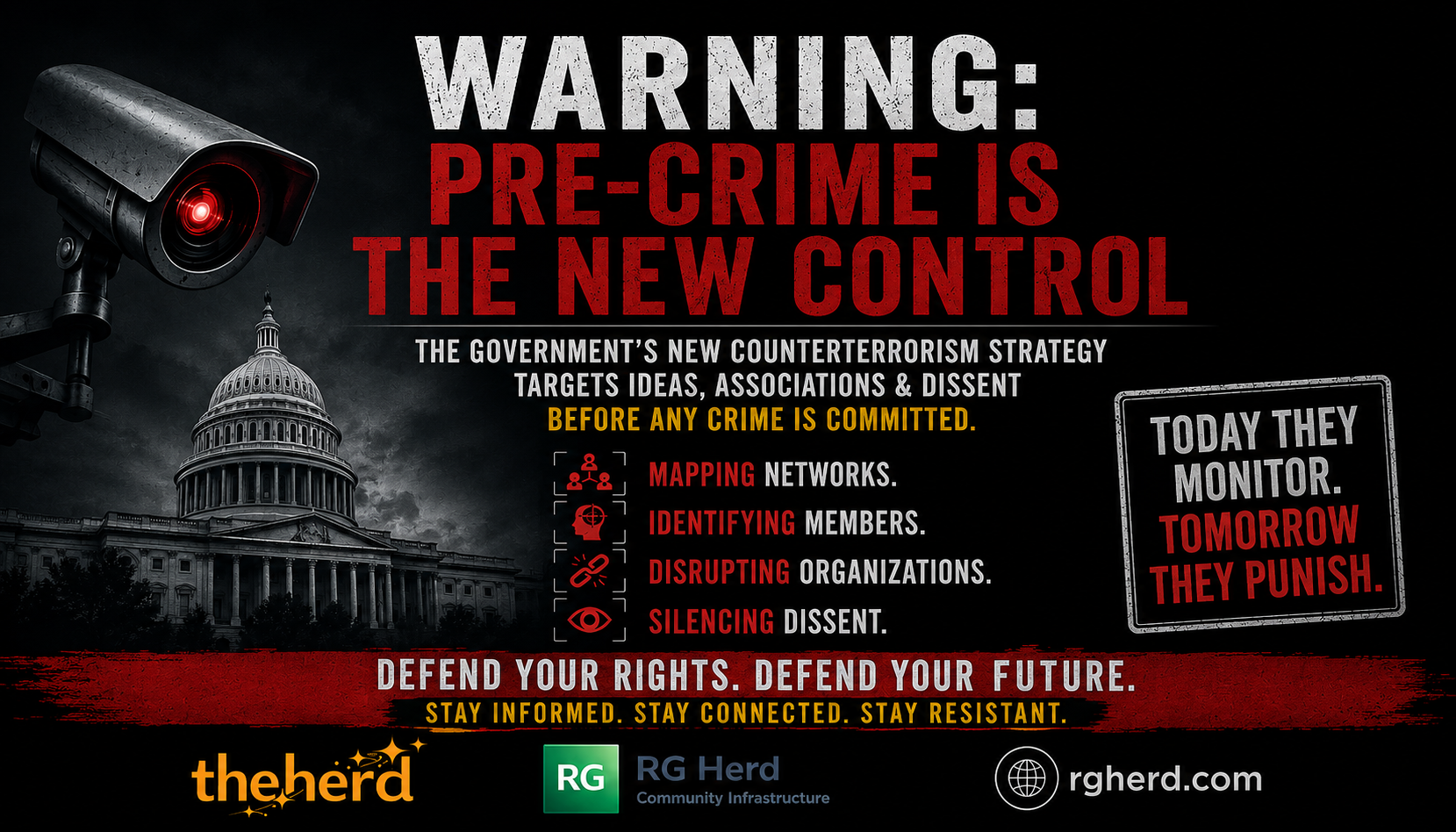
⚠️ Warning: A terrorism framework is being aimed at political ecosystems.
The most dangerous part of Trump’s new counterterrorism strategy is not that it says violence should be stopped. Violence should be stopped. Actual threats, plots, assaults, bombings, assassinations, and organized criminal activity should be investigated and prosecuted under the law.
The danger is that this strategy does something far broader. It takes the machinery of counterterrorism and points it toward ideological ecosystems, political identities, protest networks, and loosely defined domestic movements before violence occurs. That is the turn. That is the warning. That is pre-crime logic entering official national security doctrine.
On May 6, 2026, the White House released a 16-page counterterrorism strategy identifying three major threat categories: “narcoterrorists and transnational gangs,” “legacy Islamist terrorists,” and “violent left-wing extremists, including anarchists and anti-fascists.” The official document says counterterrorism powers will not be used against Americans who “simply disagree” with the administration, but later calls for rapid identification and neutralization of violent secular political groups described as anti-American, radically pro-transgender, and anarchist.
The strategy then says the government will map those groups domestically, identify membership, map ties to groups such as Antifa, and use law-enforcement tools to cripple them before they can kill or injure innocent people. That language matters. A government investigating a specific violent plot is one thing. A government mapping political networks, identifying membership, and disrupting groups before a crime occurs is something else.
The standard shifts from “what did this person do?” to “what does this person belong to, believe, attend, support, share, donate to, or associate with?” That is not a narrow counterterrorism model. That is an ideological surveillance model.
The legal line between violence and politics is one of the central protections of a free society. Once political identity becomes a predictive threat marker, every unpopular movement becomes vulnerable to the same machinery.
The hinge is “before they can.”
Reuters reported that White House counterterrorism director Sebastian Gorka described the plan as focused on neutralizing hemispheric threats and incapacitating cartel operations, but also said the domestic side would identify and neutralize violent secular political groups whose ideology he described as anti-American, radically transgender, or anarchist. He said the government would use constitutionally available tools to map those groups, identify membership, map international ties, and cripple them operationally before they could harm people.
The phrase “before they can” is the hinge. It is the point where ordinary criminal investigation begins to slide into suspicion-based political policing. Governments always claim they are preventing violence when they expand security power. The real question is what evidence is required before the state acts.
If the evidence is a specific plan, direct threat, weapons acquisition, material support, or criminal conspiracy, the state is operating in familiar legal territory. If the evidence is association, ideology, protest attendance, online speech, mutual aid work, or alleged proximity to a loosely defined movement, the state is building a pre-crime dragnet.
Investigate crimes, not ideas. Prosecute violence, not association. Target specific unlawful conduct, not broad political ecosystems.
This did not appear out of nowhere.
In September 2025, the White House issued a national security memorandum on domestic terrorism and organized political violence. Its fact sheet said the strategy would investigate, disrupt, and dismantle all stages of organized political violence, including radicalization, recruitment, funding mechanisms, NGO involvement, related financial crimes, and acts of political violence. It also said federal guidance would identify behaviors, fact patterns, and recurrent motivations common to organizations in order to stop political violence before it occurs.
That earlier memorandum also directed Treasury to identify and disrupt financial networks tied to domestic terrorism and political violence, instructed the IRS to ensure tax-exempt entities were not directly or indirectly financing political violence, and gave the Attorney General a path to recommend groups for possible domestic terrorist designation.
The September memo built the scaffolding: financial surveillance, nonprofit scrutiny, JTTF coordination, domestic terrorism grant priorities, and organization-level targeting. The 2026 strategy gives that scaffolding a sharper ideological focus.
That combination should alarm anyone who cares about the First Amendment. Political violence is already illegal. Assault, arson, threats, conspiracy, kidnapping, murder, stalking, swatting, and destruction of property are already prosecutable. The issue is not whether violence should be tolerated. It should not. The issue is whether the government is now preparing to treat entire political environments as suspect infrastructure.
The Antifa problem is the vagueness.
The official strategy’s treatment of “Antifa” is especially dangerous because Antifa is not a conventional membership organization with a headquarters, roster, dues system, or command structure. It is a loose label applied to a wide range of anti-fascist beliefs, protest cultures, street-level groups, online communities, and political opponents.
Trying to “identify membership” in something that vague invites exactly the kind of dragnet abuse the government claims it will avoid. This is how a terrorism label becomes a political weapon. First, officials identify an ideology as dangerous. Then they identify a movement. Then they search for membership. Then they map associates. Then they trace funding. Then they pressure nonprofits, universities, payment processors, platforms, and local police departments to cooperate.
Eventually, a person does not need to commit violence to be treated as a threat. They only need to appear inside the mapped ecosystem.
None of this requires defending violence. It requires defending the boundary between violence and politics. That boundary is what prevents counterterrorism from becoming political policing.
The threat picture is not as simple as the administration’s framing.
Security analysts have already warned that the threat picture is not as simple as the administration’s framing suggests. CSIS found that left-wing attacks and plots have risen in recent years, but from very low levels, and still remain much lower than historical levels of violence from right-wing and jihadist attackers. CSIS also warned that right-wing terrorism could return to previous high levels and argued that counterterrorism must be resourced across both left- and right-wing threats without overreaction.
That matters because a serious counterterrorism strategy should track the actual threat landscape, not merely the administration’s preferred enemies. ADL’s 2024 extremism murder report found that all identified extremist-related murders that year were committed by right-wing extremists, including white supremacists and far-right anti-government actors. ADL also reported that, over the past decade, far-right extremists were responsible for the large majority of extremist-related murders.
Yet reporting on the 2026 strategy noted that it does not mention far-right or white supremacist ideology while singling out left-wing, anti-fascist, anarchist, and pro-transgender ideology. Critics have warned that this framing collapses disfavored communities and broad portions of the political left into a terrorism frame, creating a pretext for repression of dissent, migrants, Muslims, transgender people, and their allies.
This is the Crimson Drift pattern.
This is the Crimson Drift pattern in plain sight: security language, surveillance tools, ideological labeling, and due process erosion moving together. The existing Crimson Drift framework has tracked this convergence as the fusion of advanced surveillance technology with weakening oversight and executive-power expansion.
The core warning has always been that isolated systems become far more dangerous when joined into a political enforcement architecture. A fusion center is one thing. A protest intelligence bulletin is one thing. An IRS inquiry is one thing. A domestic terrorism memo is one thing. A social media monitoring contract is one thing. But when those tools are aligned around a political enemy category, the result is not normal administration. It is an enforcement ecosystem.
The legal line matters. GAO summarizes the statutory domestic terrorism framework as conduct that occurs primarily inside U.S. territory, involves acts dangerous to human life that violate criminal law, and appears intended to intimidate civilians, influence government policy by intimidation or coercion, or affect government conduct through mass destruction, assassination, or kidnapping. FBI and DHS documentation similarly defines domestic violent extremism around unlawful force or violence, not mere ideology.
That is the standard that must not be blurred. The state can investigate violence. It can investigate credible threats. It can investigate criminal conspiracies. It cannot be allowed to quietly convert dissent, identity, protest, journalism, legal defense, mutual aid, anti-fascist belief, LGBTQ+ advocacy, or anti-authoritarian organizing into terrorism indicators.
The practical risk is chilling pressure.
The practical risk is not just mass arrests. It is chilling pressure across the whole civic ecosystem. Nonprofits may avoid controversial work because they fear IRS scrutiny. Universities may discipline students because federal agencies imply protest activity is extremism. Payment processors may flag donations. Local police may feed protest intelligence into fusion centers. Journalists may avoid sources. Organizers may stop communicating. Ordinary people may decide that showing up is not worth the risk.
That is how political freedom gets strangled without a single formal ban. The government does not need to outlaw dissent if it can make dissent administratively dangerous.
Warning signs to watch now
The warning signs to watch now are specific: DOJ guidance expanding domestic terrorism indicators; JTTF involvement in protest-related cases; Treasury or IRS scrutiny of nonprofits tied to protest movements; fusion-center bulletins referencing Antifa, anarchists, transgender ideology, or “anti-American” networks; subpoenas for donor lists or communications; pressure on platforms to identify organizers; and local grant programs rewarding police departments for domestic extremism surveillance.
None of this requires defending violence. It requires defending the boundary between violence and politics. That boundary is one of the central protections of a free society. Once the government begins treating political identity as a predictive threat marker, every unpopular movement becomes vulnerable to the same machinery.
The rule should be simple: investigate crimes, not ideas. Prosecute violence, not association. Target specific unlawful conduct, not broad political ecosystems. The government does not get to call dissent terrorism just because dissent makes power uncomfortable.
The warning
This strategy is not just a counterterrorism document. It is a test of whether Americans still understand the difference between public safety and political control.
Public safety requires clear evidence, narrow targeting, due process, and accountable institutions. Political control requires vague enemy categories, ideological threat labels, network mapping, financial pressure, and preemptive disruption. The 2026 strategy moves too close to the second model to ignore.
The line has to be defended now, before the machinery hardens. Violence is illegal. Dissent is not.
Sources / reference points
- White House: 2026 U.S. Counterterrorism Strategy
- Reuters: Trump signs new counterterrorism strategy
- The Guardian: Analysis of Trump counterterrorism policy
- CSIS: Left-wing terrorism and political violence in the United States
- ADL: Murder and Extremism in the United States in 2024
- GAO: Countering Domestic Terrorism and Violent Extremism
- White House: Countering Domestic Terrorism and Organized Political Violence