
Introduction
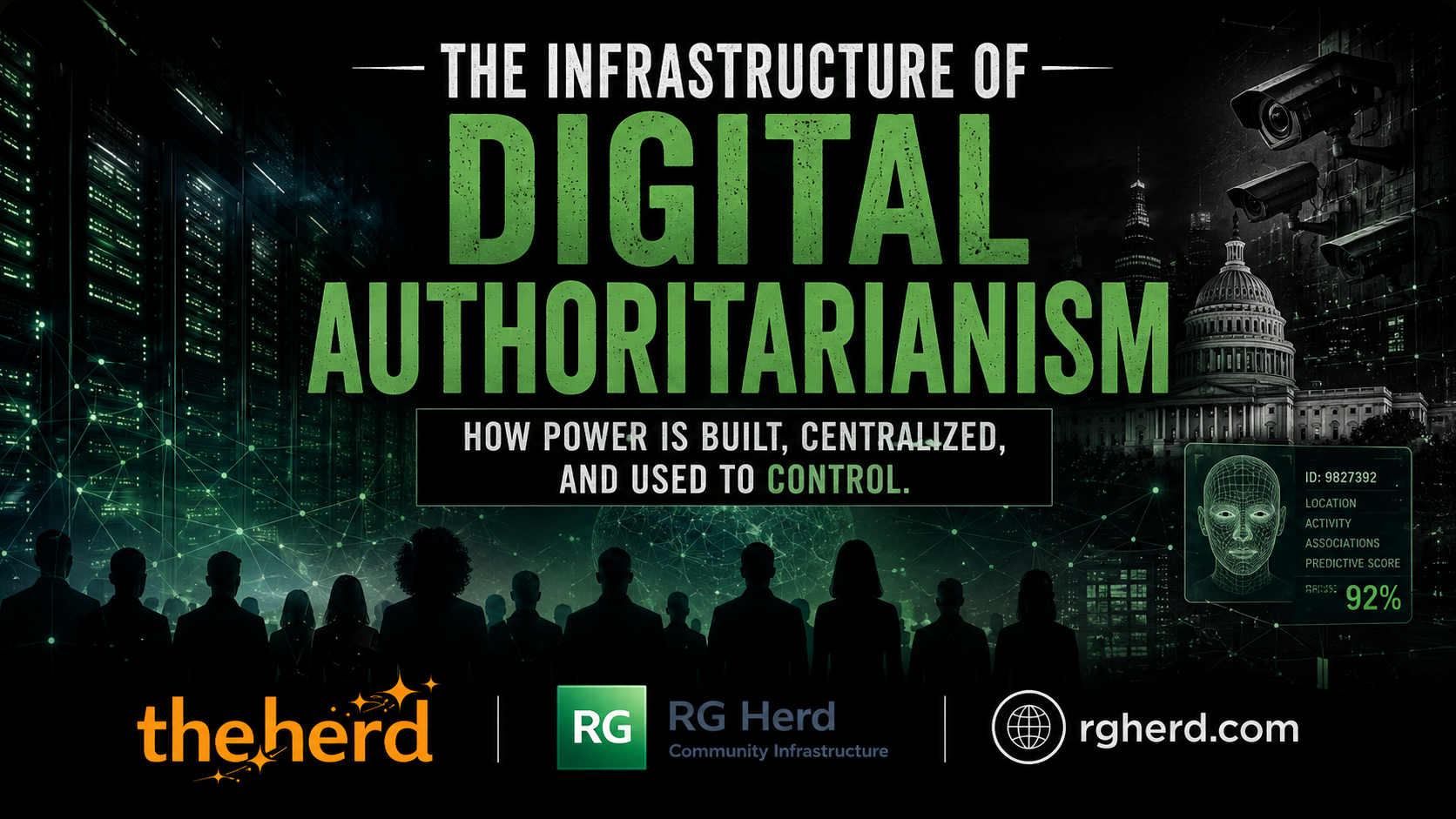
Across the United States, enormous datacenters are rising from deserts, farmland, industrial corridors, and suburban outskirts. Entire regions are being reshaped around the computational demands of artificial intelligence, hyperscale cloud infrastructure, and real-time data processing. Publicly, this buildout is framed as innovation: AI productivity, smart infrastructure, fraud prevention, national competitiveness, personalized services, and faster cloud computing. That framing is not false, but it is dangerously incomplete. Infrastructure does not care about intent. Once built, infrastructure creates capability, and capability changes power.
The same compute systems that generate AI images can also process nationwide facial recognition streams. The same cloud architecture that powers recommendation engines can centralize immigration databases, predictive policing systems, biometric identity verification, financial monitoring, geolocation analysis, and behavioral modeling at population scale. The political question is not whether every datacenter is being built for repression. The political question is what becomes possible once the physical capacity exists, who controls it, and what kind of government inherits it.
Why This Matters
Modern authoritarianism does not primarily rely on tanks in the streets. It relies on databases, integrated surveillance, automated enforcement systems, predictive analytics, administrative dependency, and compliance pressure. The danger is not a cartoon dystopia appearing overnight. The danger is the gradual normalization of a society where every interaction, movement, transaction, and behavioral pattern becomes machine-readable, permanently stored, algorithmically scored, and politically usable.
Every government inherits the infrastructure built by the governments and corporations before it. Surveillance systems created for immigration enforcement can later be used against protesters. Financial monitoring tools justified by fraud prevention can later be expanded into political targeting systems. Predictive analytics designed for counterterrorism can migrate into labor surveillance, dissident tracking, or automated risk scoring. This is why datacenters matter politically: they are not just buildings full of servers. They are the physical foundation for centralized computational power.
Datacenters Are Political Infrastructure
Datacenters are often discussed as neutral technical facilities, but they are power concentration infrastructure. Artificial intelligence at national scale requires immense centralized compute capacity: massive GPU clusters, hyperscale cloud architecture, high-bandwidth networking, industrial cooling systems, and continuous electrical power. This creates a structural reality: data centralizes, compute centralizes, identity systems centralize, analytic capability centralizes, and power centralizes. The organizations capable of operating these systems are increasingly limited to governments and a small number of giant corporations.
A government with fragmented records and slow bureaucracy has limited capacity for mass social control. A government integrated with centralized AI infrastructure can process populations in real time. Datacenters are not simply warehouses for information. They are the physical foundation for continuous computational governance. Every new hyperscale facility expands the capacity for biometric processing, persistent identity resolution, population-scale behavioral modeling, automated monitoring, real-time predictive analytics, cross-platform data fusion, and AI-assisted enforcement operations.
The Mechanics of Digital Authoritarianism
Digital authoritarianism functions through administrative dependency and behavioral predictability. The operational model is straightforward: collect massive amounts of behavioral and identity data, centralize and integrate those datasets, use AI systems to identify patterns and risks, then automate decision-making and enforcement wherever possible. The point is not constant physical coercion. The point is to make resistance administratively difficult, socially expensive, and increasingly visible to systems that can punish it without a dramatic public spectacle.
In this model, coercion becomes administrative. Access can be delayed, accounts can be flagged, travel can become difficult, financial systems can freeze or scrutinize transactions, risk scores can trigger additional review, platforms can suppress visibility, employers can receive automated behavioral assessments, and agencies can act on machine-generated suspicion before any meaningful human review occurs. None of this requires martial law. It requires integrated databases, automated workflows, and enough public acceptance to treat the system as normal.
AI + Surveillance Integration
The most important shift underway is not surveillance alone. It is the integration of surveillance with artificial intelligence. Raw surveillance data has limited value without systems capable of processing it at scale. AI changes that equation completely. Machine-learning systems can track individuals across camera networks, identify faces in crowds, analyze social networks, predict movement patterns, detect behavioral anomalies, infer relationships between datasets, generate automated risk assessments, and flag “suspicious” patterns without meaningful human review.
The trend line is unmistakable: fragmented surveillance systems are converging into unified machine-readable governance ecosystems. Fusion centers, real-time crime centers, federal databases, biometric systems, commercial data brokers, and platform analytics increasingly operate as pieces of a larger administrative machine. AI is the force multiplier that makes those ecosystems operationally viable at national scale.
Administrative Automation Replaces Overt Force
Large-scale digital control systems reduce the need for constant visible repression. When populations know they are continuously monitored, behavior changes automatically. The objective becomes predictive management rather than reactive violence. Instead of waiting for dissent to emerge physically, systems identify elevated “risk” early through digital signals: travel patterns, financial activity, social associations, online behavior, location history, communication metadata, platform engagement, and attendance at events.
Once integrated, these systems allow authorities to map social networks, identify organizers, monitor ideological trends, and selectively apply pressure. The result is not always mass imprisonment. Often the result is widespread self-censorship and passive compliance. People avoid protests, avoid political speech, avoid association with targeted groups, and avoid visibility altogether. Fear becomes infrastructural.
Convenience Is the Delivery Mechanism
Most people do not willingly opt into authoritarian systems. They opt into convenience. Faster authentication, smarter assistants, frictionless payments, fraud prevention, personalized recommendations, public safety tools, seamless digital identity systems, and efficient administration are the mechanisms through which surveillance systems normalize themselves socially. Every convenience platform becomes a data-collection platform. Every identity layer becomes a monitoring layer. Every integrated system increases dependency on centralized infrastructure controlled by institutions far larger than the individual.
Once populations become structurally dependent on centralized digital systems, resistance becomes materially harder. Opting out increasingly means exclusion from economic and social life. That is the real political power of digital infrastructure: it turns participation into dependence, dependence into compliance, and compliance into a default condition of citizenship.
The Core Warning
The United States is not building a cartoon dystopia. It is building computational infrastructure capable of supporting unprecedented levels of centralized administrative power. Some of this infrastructure will produce beneficial technologies. AI systems can improve medicine, logistics, accessibility, and scientific research. But the political implications of concentrated compute, integrated identity systems, and AI-enhanced surveillance cannot be ignored simply because the consumer applications are useful.
The question is not whether these systems can be used for authoritarian governance. The documented capabilities already demonstrate that they can. The real question is whether democratic institutions, civil-liberties protections, transparency laws, and public awareness will evolve fast enough to constrain them before they become permanent. Infrastructure is destiny more often than ideology. Once a society builds systems capable of population-scale behavioral surveillance and automated administrative control, every future government inherits the temptation to use them. That is why the datacenter boom matters politically.
Sources / reference points
- Reuters reporting on AI infrastructure, datacenter expansion, cloud concentration, hyperscale compute, and energy demand
- Associated Press reporting on artificial intelligence infrastructure, datacenter construction, and public policy impacts
- Electronic Frontier Foundation reporting on surveillance systems, real-time crime centers, ALPR networks, and police data fusion
- ACLU reporting on facial recognition, biometric surveillance, digital identity systems, and civil-liberties risks
- Brennan Center analysis on predictive policing, fusion centers, protest surveillance, and counterterrorism authorities
- Department of Homeland Security AI Use Case Inventory
- Government Accountability Office reporting on federal AI, facial recognition, and biometric oversight gaps
- Federal Trade Commission materials on commercial surveillance, privacy enforcement, and platform governance
- Federal Communications Commission materials on communications infrastructure and digital systems policy
- Public reporting and procurement references involving Palantir government analytics systems
- Flock Safety automated license plate reader infrastructure context
- Clearview AI facial-recognition platform context and reporting