
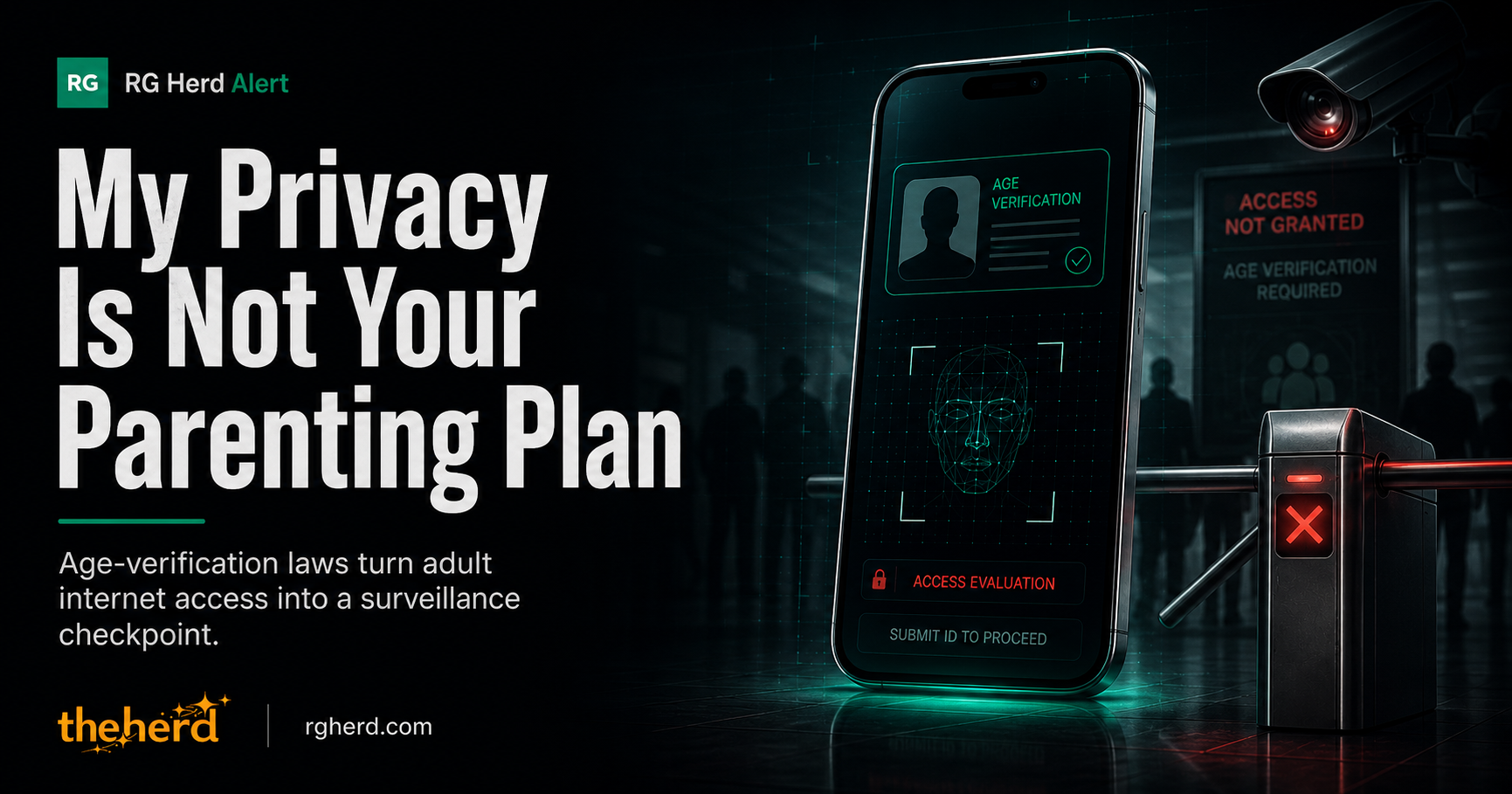
⚠️ Warning: Child safety is being used to normalize identity-gated internet access.
There is a sentence every adult should be willing to say out loud: my privacy is not your parenting plan. That is the real issue hiding underneath the age-verification debate. Lawmakers are not simply asking websites to protect kids. They are building a system where adults must prove who they are before accessing lawful parts of the internet because parents, politicians, and platforms have failed to deal honestly with children’s online lives.
That is not child safety. That is the nanny state reaching into everyone’s device. The sales pitch is always soft: protect the children, keep minors away from harmful content, make platforms responsible, and give parents tools. On the surface, that sounds reasonable. Children do need protection from exploitation, predatory adults, addictive platform design, algorithmic manipulation, and corporate data harvesting. But age-verification laws do not stop at children. They force the entire public through the filter.
To identify minors online, platforms have to assess everyone. That means every adult becomes part of the enforcement mechanism. Your phone, browser, account, face, ID, device fingerprint, location, app-store profile, and private adult life become a compliance surface for someone else’s household problem. That is the line. Protecting children does not require converting every adult’s device into a government-approved checkpoint.
The fight is not only about adult websites or social media. The deeper fight is whether ordinary internet access becomes conditioned on identity, age category, device status, vendor approval, or state-approved verification.
This is not parenting. This is infrastructure.
Age verification is no longer a fringe policy experiment. The Electronic Frontier Foundation reported that by the end of 2025, half of the United States had some form of age-verification mandate for adult content or social media platforms, with more taking effect in 2026. The National Conference of State Legislatures’ 2026 tracking also shows continued state activity around minors, social media, addictive content, consent, notifications, and age verification. In plain English: this is becoming infrastructure.
That matters because laws like this do not merely regulate websites. They create habits. They teach the public that identity checks are normal. They teach platforms that lawful access can be conditioned on age gates. They teach governments that if they attach the words “child safety” to a proposal, they can get adults to accept surveillance architecture they would reject in almost any other context.
The public would not tolerate a police officer standing outside a bookstore asking adults to show ID before entering the politics, sexuality, health, religion, or self-education section. But move that same checkpoint into a browser window, outsource it to a vendor, call it “age assurance,” and suddenly politicians expect applause. A checkpoint is still a checkpoint when it is digital.
The trick is making every adult responsible for every child.
The moral inversion is nasty. Instead of saying parents need to parent, lawmakers are saying strangers need to surrender privacy. Instead of saying platforms should stop designing addictive systems for children, lawmakers are saying adults should prove their identity before using the internet. Instead of confronting the fact that devices are being used as babysitters, the state is trying to turn everyone’s device into a babysitting enforcement node.
That is backwards. Parents have duties. Platforms have duties. Schools and communities have roles. But adults without children should not be forced to upload documents, scan faces, verify accounts, expose browsing habits, or surrender anonymity because another household wants the government to childproof the internet on its behalf. Your kid is not a warrant for my device. Your anxiety is not a privacy exception. Your parenting problem does not authorize a surveillance regime over everyone else.
A phone is not a babysitter. A browser is not a daycare worker. An app store is not a family structure. My private internet use is not a public resource for lawmakers to conscript into someone else’s parenting plan.
“Age assurance” still means adult inspection.
Supporters often avoid the phrase “ID check” and use softer language like “age assurance.” That sounds less invasive, but the practical question remains: how does the system decide who is a child and who is an adult? There are only a few paths. A platform can ask for government ID. It can rely on third-party verification vendors. It can estimate age through biometrics or facial analysis. It can infer age from behavioral signals. It can use device-level or app-store-level age categories. It can combine signals from accounts, devices, location, payment systems, and browsing patterns.
Every version creates risk. Some systems collect sensitive documents. Some create biometric exposure. Some normalize behavioral profiling. Some shift the checkpoint deeper into the operating system or app store. Some outsource trust to private companies that most users have never heard of. Even when a system claims not to store the data, users are still being forced into a pipeline that can fail, leak, be subpoenaed, be repurposed, or be expanded later.
Once the infrastructure exists, future lawmakers will find new uses for it. The first justification is children. The next justification can be extremism, misinformation, gambling, drugs, “harmful content,” political unrest, encrypted communication, protest organizing, or whatever moral panic is useful next.
The question is not whether children deserve protection. They do. The question is whether protecting children requires building surveillance infrastructure around everyone else. It does not.
The Supreme Court did not make this harmless.
In 2025, the Supreme Court upheld Texas’s age-verification law for sexual content in Free Speech Coalition v. Paxton. Civil-liberties groups warned that the ruling was a blow to free speech and privacy, while also emphasizing that the decision was limited and did not authorize age verification for non-sexual online content. That distinction matters, because the danger now is expansion. Lawmakers are already pushing age verification beyond adult websites and into social media, app stores, operating systems, feeds, and device-level controls.
The fight is not only over whether minors can access explicit material. The fight is over whether adults will need permission slips to use the internet privately. The state does not have to ban lawful speech if it can make access humiliating, traceable, risky, or inconvenient. It does not have to read every page you visit if it can condition access on identity. It does not have to censor everything if it can make people hesitate before clicking. That hesitation is the control mechanism.
VPN targeting shows where this is going.
Utah’s Senate Bill 73 makes the direction obvious. The law, effective May 6, 2026, treats users physically located in Utah as Utah users even if they use VPNs or proxies to mask location, and it bars sites from sharing information about bypassing age checks with VPNs. That is not just child protection. That is a direct collision with privacy tools.
VPNs are used by journalists, activists, abuse survivors, travelers, workers on hostile networks, cybersecurity professionals, and ordinary people who simply do not want every ISP, advertiser, platform, and data broker watching them. Treating VPN use as a compliance threat exposes the deeper logic: privacy itself becomes suspicious when the state wants enforceable identity online. When a child-safety law starts punishing privacy-preserving behavior, the mask is off.
The data problem does not disappear because lawmakers promise safety.
Any system that verifies identity creates sensitive data trails. Government IDs, face scans, verification tokens, device identifiers, location claims, account records, parental consent links, and access attempts all create value for someone. Vendors want markets. Platforms want liability shields. Governments want enforceability. Law enforcement wants access. Hackers want databases. The user is left carrying the risk.
Supporters will say the data can be deleted. Maybe sometimes. They will say vendors can use privacy-preserving methods. Maybe sometimes. They will say adults can trust the system. Absolutely not. Trust is not a privacy policy. Trust is not a safeguard. Trust is what institutions demand when they do not want enforceable limits. If the state wants to force identity infrastructure onto adult internet use, the burden is not on the public to prove why that is dangerous. The burden is on the state to prove why it has any right to do that in the first place.
Real child safety does not require universal adult checkpoints.
There are better answers than this. Parents can use device-level controls, router-level controls, supervised accounts, app-store restrictions, content filters, time limits, family rules, and actual conversations. Schools can teach digital literacy. Communities can support overwhelmed parents. Lawmakers can regulate manipulative design, targeted advertising to minors, dark patterns, exploitative recommendation systems, and corporate data harvesting without forcing every adult through an identity gate.
Those approaches are not perfect. Parenting is not perfect. Safety is not perfect. But freedom requires refusing the fantasy that every social problem can be solved by surveillance. The state cannot parent every child through every adult’s device, and it should not be allowed to pretend that adult privacy is the price of someone else’s convenience.
The warning
Age verification is being framed as a child-safety measure. In practice, it is a normalization campaign for identity-gated internet access. That should alarm everyone, because once adults accept that they must prove who they are to access lawful speech, the open internet changes character. It becomes less like a public square and more like a controlled facility; less like reading in private and more like signing in at a checkpoint; less like freedom and more like permission.
The question is not whether children deserve protection. They do. The question is whether protecting children requires building surveillance infrastructure around everyone else. It does not. My privacy is not your parenting plan.
Sources / reference points
- Electronic Frontier Foundation: The Year States Chose Surveillance Over Safety
- Electronic Frontier Foundation: 10 Not-So-Hidden Dangers of Age Verification
- ACLU: Comment on Free Speech Coalition v. Paxton
- Supreme Court opinion: Free Speech Coalition, Inc. v. Paxton
- National Conference of State Legislatures: Social Media and Children 2026 Legislation
- Tom’s Hardware: Utah age-verification law and VPN liability